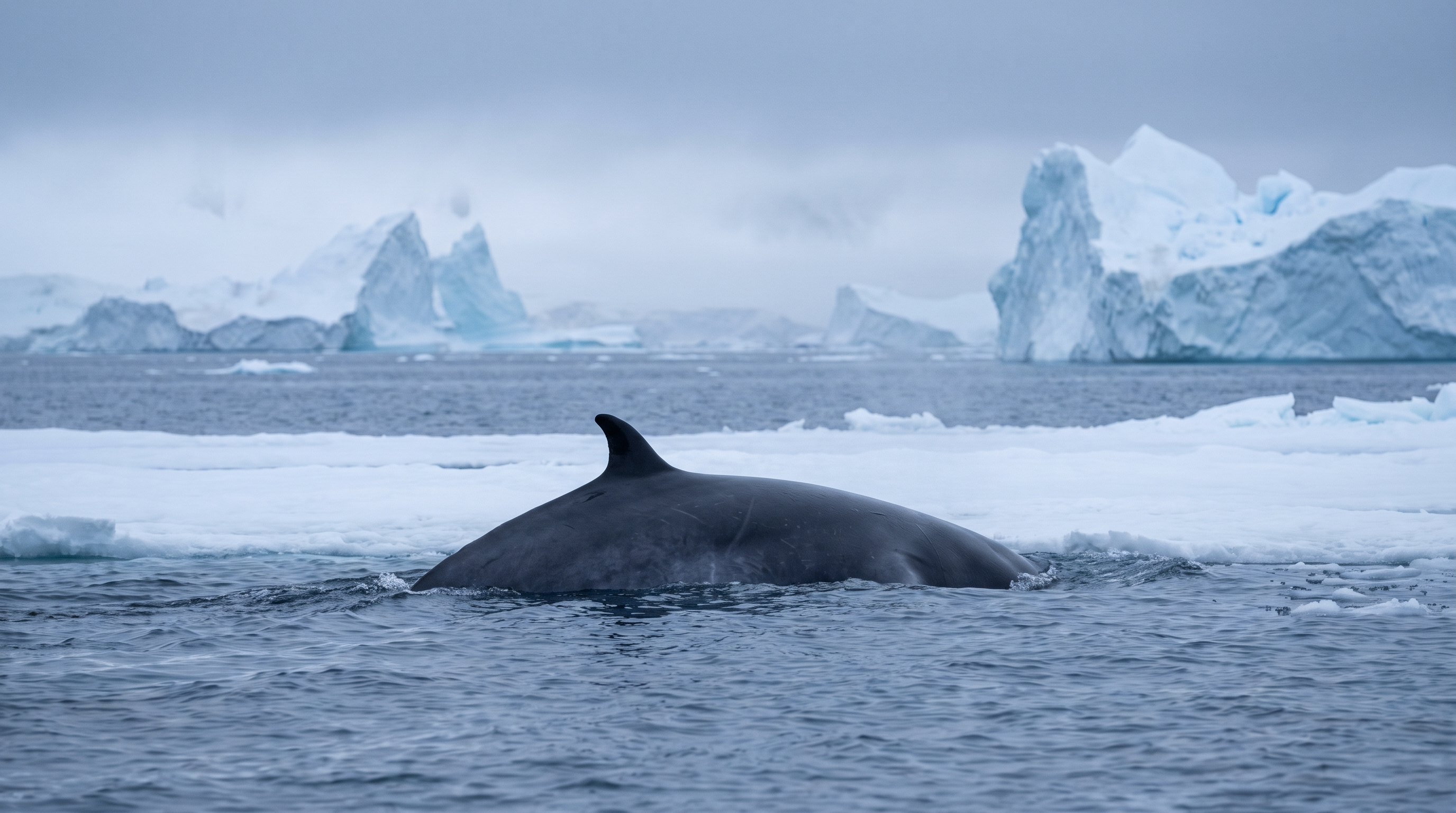
Antarctic Minke Whales
Balaenoptera bonaerensis · also called Southern Minke Whale · Baleen whale
The Antarctic minke whale is the southern counterpart to the common minke, spending its summers feeding at the edge of the Antarctic pack ice.
Classification
| Kingdom | Animalia |
| Phylum | Chordata |
| Class | Mammalia |
| Order | Cetacea |
| Family | Balaenopteridae |
| Genus | Balaenoptera |
| Species | bonaerensis |
Description
Antarctic minke whales are dark gray with a lighter underside and, unlike the common minke, lack a bright white band on the flippers, showing a more diffuse gray patch instead.
Size
Slightly larger than the common minke, Antarctic minke whales grow up to 35 feet in length and weigh as much as 10 tons.
Did You Know?
Antarctic minke whales follow the retreating sea ice every summer to reach the dense krill swarms that gather at its edge.
Habitat
Found exclusively in the Southern Hemisphere, Antarctic minke whales migrate each summer to the edge of the Antarctic pack ice to feed, retreating to lower latitudes in winter.
Diet
Antarctic minke whales feed almost exclusively on Antarctic krill, a keystone species at the base of the Southern Ocean food web.
Whaling history
Antarctic minke whales were the primary target of Japan's former "scientific research" whaling program in the Southern Ocean, making them the most heavily hunted large whale of recent decades.