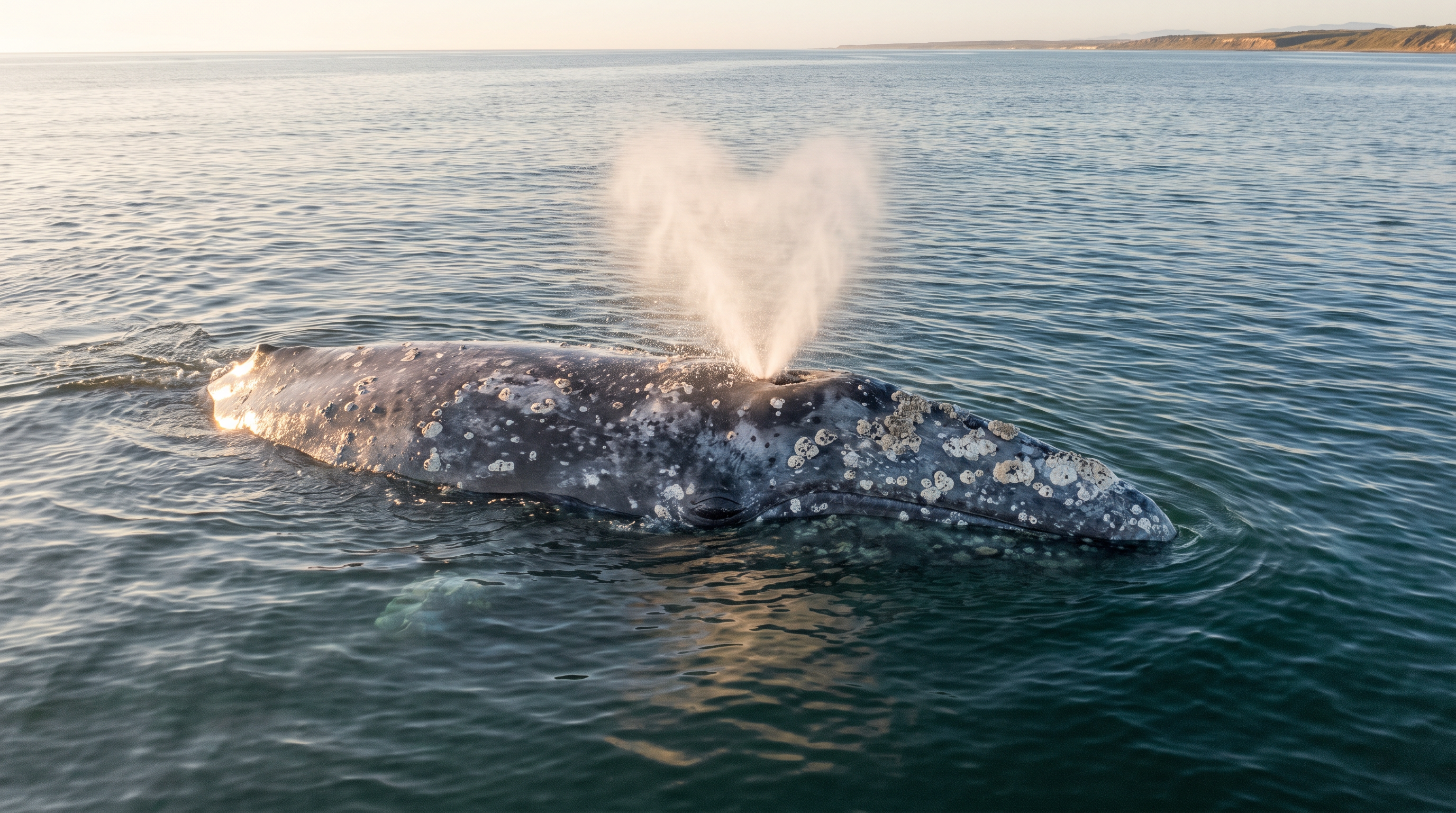
Gray Whales
Eschrichtius robustus · Baleen whale
The gray whale is a species of large baleen whale, the only member of the taxonomic genus Eschrichtius as well as the family Eschrichtiidae.
Classification
| Kingdom | Animalia |
| Phylum | Chordata |
| Class | Mammalia |
| Order | Cetacea |
| Family | Eschrichtiidae |
| Genus | Eschrichtius |
| Species | robustus |
Habitat
The gray whale can be found in the north of the Pacific Ocean, where two populations exist. One resides in the west near southern Korea and is considered critically endangered, with a total of only 130 individuals. The other, found between Alaska and Baja California Sur, is much larger, containing over 20,000 individuals.
Description
As its name suggests, the gray whale is dark gray in color, with distinct white and gray markings across its skin caused by parasites that attach to the whale but drop off in cold, deep waters. It is also distinguished by its two blow holes and its off-white, atypically short baleen.
Did You Know?
The gray whale's migration may be the longest of any mammal, covering up to 13,700 miles round trip.
Size
On average, the gray whale measures 43 to 49 feet in length and weighs 15 to 33 tons, reaching up to 40 tons at its largest. Females are typically larger than males.
Diet
As a baleen whale, the gray whale is a filter-feeder, subsisting primarily on crustaceans found in the deepest layer of the ocean. It feeds by turning its head to one side and filling its mouth with sediment, then filtering the mixture through its baleen. It feeds most in the north during summer, relying on fat stores while migrating.
Migration
The gray whale migrates yearly starting in October, traveling an average of 75 miles per day at about five miles per hour, covering 9,900 to 13,700 miles round trip — perhaps the longest migration of any animal. The migration also serves as a trek to breeding lagoons, with most whales arriving by mid-February to mid-March.