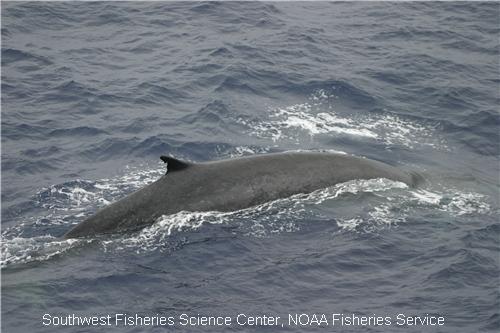
Fin Whales
Balaenoptera physalus · also called Finback Whale, Razorback, Greyhound of the Sea · Baleen whale
The fin whale is the second-largest animal on Earth after the blue whale, a long, slender baleen whale nicknamed the "greyhound of the sea" for its speed.
Classification
| Kingdom | Animalia |
| Phylum | Chordata |
| Class | Mammalia |
| Order | Cetacea |
| Family | Balaenopteridae |
| Genus | Balaenoptera |
| Species | physalus |
Description
Fin whales have a distinctive asymmetrical coloring on their lower jaw — dark gray on the left side and white on the right — a trait unique among whales and thought to play a role in feeding technique. Their bodies are long, slender, and streamlined.
Size & speed
Fin whales measure 60 to 85 feet in length and weigh 40 to 80 tons. They are among the fastest of the great whales, capable of sustained speeds around 23 miles per hour, earning the nickname "greyhound of the sea."
Did You Know?
Fin whales have asymmetrical coloring on their jaw — dark on the left, white on the right — unlike any other whale.
Habitat
Fin whales are found in oceans worldwide, from tropical to polar waters, though they are most common in temperate and cold seas, often migrating seasonally between feeding and breeding grounds.
Diet
Fin whales feed on krill, small schooling fish, and squid, lunging through dense prey patches and filtering food through their baleen plates.
Social structure
Fin whales are typically seen alone or in small groups of two to seven, though they may gather in larger, loose aggregations where food is abundant.
Conservation
Fin whales were heavily hunted during the whaling era and remain listed as vulnerable, though populations in some regions have shown signs of recovery since commercial whaling bans took effect.